
Another Language:
 日本語
日本語
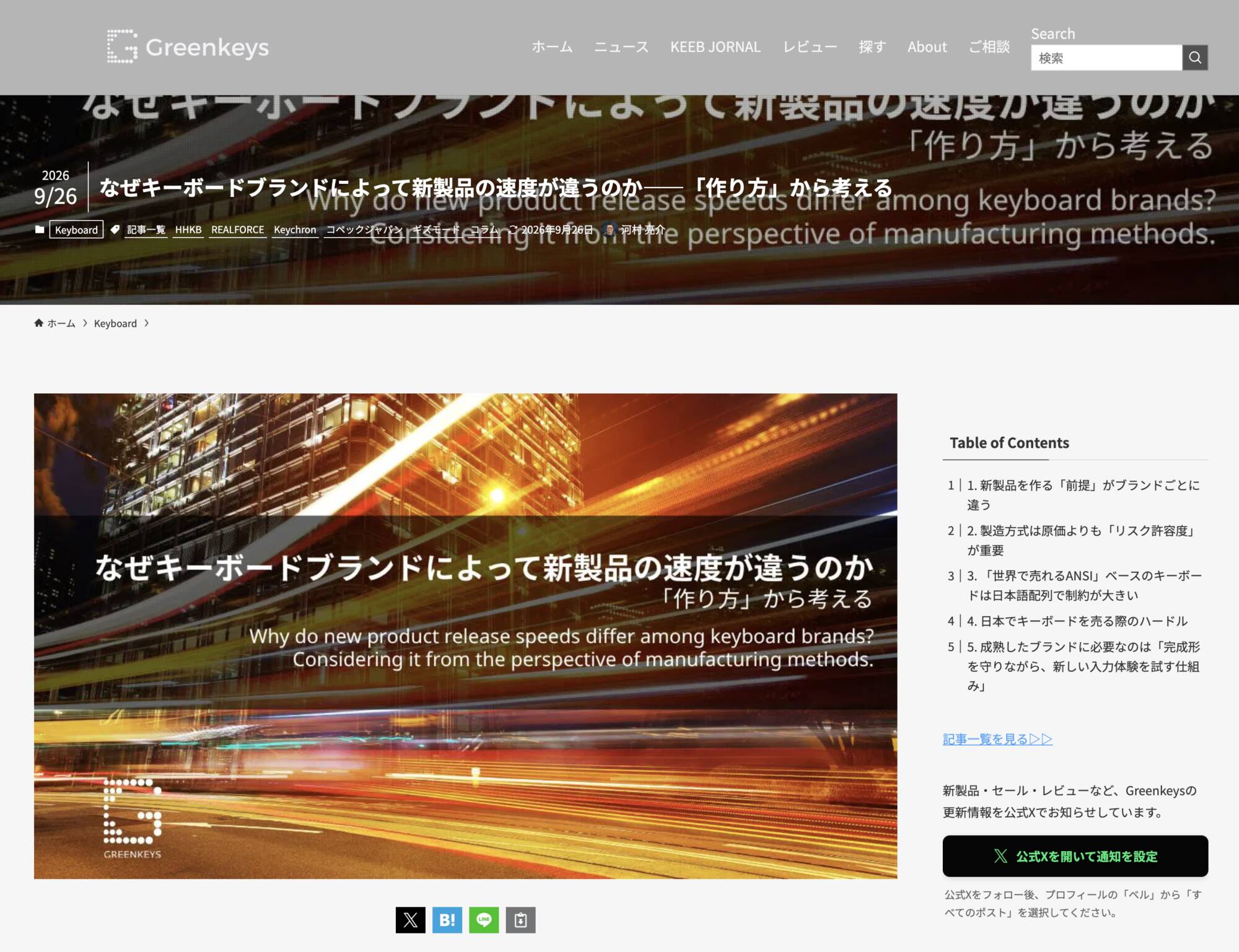
GreenEchoes Studio has published a column on Greenkeys, a media outlet specializing in keyboards and input devices, examining why keyboard brands differ in how quickly they can bring new products to market.
Rather than making a simplistic comparison such as “Japanese companies are slow” versus “overseas companies are fast,” this article examines the mechanisms of product development from multiple angles, including manufacturing systems, production methods, investment recovery, reuse of design assets, localization, and sales channels.
In the main Greenkeys article, we compare brands with different product development and manufacturing models—including REALFORCE, HHKB, ELECOM, and Keychron—to examine how each makes its products.
The Speed of New Product Development Isn’t Determined by Development Capabilities Alone
When it comes to the speed of creating new products, people tend to focus on differences in planning and development capabilities.
However, there is more to it than that.
Take keyboard housings, for example: the investment required before commercialization differs significantly between CNC machining and injection molding.
Since CNC machining does not require large-scale production molds, it is easier to bring products to market in relatively small quantities. Injection molding, on the other hand, requires upfront investment in molds, so companies need to consider whether sales volume will be sufficient and how long it will take to recoup that investment. Why does the pace of new product development differ among keyboard brands…
In other words, the speed at which a company can bring a new product to market is strongly influenced by its business structure —specifically, how little risk it can take when testing a product whose market potential is still uncertain.
The Manufacturing Cluster in China’s Pearl River Delta Also Supports Product Development Speed
This article also looks at manufacturing regions.
In particular, the Pearl River Delta, centered on Shenzhen and Dongguan, is home to a concentration of companies essential to electronics manufacturing, including those specializing in electronic components, PCBs, CNC machining, mold making, injection molding, surface treatment, and assembly.
In this kind of environment, a single company does not need to handle every manufacturing process. By combining multiple specialized companies through a horizontal division of labor, a product can move from prototyping to mass production relatively quickly.
What matters is not simply the difference in labor costs.
We believe that having the necessary technologies and manufacturing companies nearby—and being able to iterate quickly during product development—is itself a source of regional competitiveness.
“Localization” Is Necessary to Bring Global Products to the Japanese Market
Being able to manufacture a product does not necessarily mean it can be sold in the Japanese market.
For keyboards, the physical layouts differ between ANSI, ISO, and JIS.
For Japanese layouts in particular, changing the keycaps alone may not be enough; adjustments to the PCB, plate, key layout, firmware, and keymap may also be needed.
Adapting to the Japanese market involves more than product specifications.
The full customer-facing setup needs to be in place, including sales pages, payment, domestic shipping, warranties, repairs, and support in Japanese.
In the main Greenkeys article, we also examine how multiple companies share responsibility for product development, domestic distribution, and understanding the market, using the collaboration between Keychron, Kopek Japan, and GIZMART as an example.
The Speed of Making a Product and the Speed of Connecting It to a Market Are Different Capabilities
This analysis reinforced the point that product development is about more than simply being able to make a good product.
Identify new needs.
Turn them into products at a realistic cost.
Localize the products for the markets where they will be sold.
Build distribution and support systems that let customers in those markets buy with confidence.
Then feed market responses into the next product.
A new product reaches the market only when this entire process is connected.
In the main Greenkeys article, we also concluded that assessing a keyboard brand’s competitiveness requires looking not only at the “speed of making” a product but also at the “speed of connecting” it to a regional market. Why does the pace of new product development differ among keyboard brands…
GreenEchoes Studio Supports the Work of Connecting Products to the Market
At GreenEchoes Studio, we support product development and sales for the Japanese market, focusing on keyboards and input devices.
We do more than place advertisements. From the product planning stage, we consider how products will be used in Japan and, as needed, review their specifications, layouts, and messaging. At launch, we also support information outreach through Greenkeys and the collection of market feedback.
Our main services currently include:
| Services | Main Details |
|---|---|
| Product Oversight | Review of specifications, suitability for the Japanese market, and the input experience |
| Localization | Review of Japanese layouts, key placement, and specifications for the Japanese market |
| Market Research | Quantitative and qualitative research into responses from Greenkeys readers |
| Launch Support | Information outreach covering teasers, launch announcements, and post-launch follow-up |
| Reviews | Product evaluations and content creation based on hands-on testing |
| Reporting and Interviews | Articles based on coverage of exhibitions and events, and interviews with company representatives |
At GreenEchoes Studio, we believe localization means not only introducing products developed overseas to Japan but also feeding Japanese market needs into product planning, developing them into viable products, and connecting them to sales.
Turning New Input Experiences into Real Products
With the spread of generative AI and changes in work styles, expectations for keyboards themselves are beginning to change.
Keyboards are expected to do more than enable typing: they may integrate pointing devices, offer layouts suited to the user’s body, be compact and portable, or provide an enjoyable design and ownership experience.
In this market, it is important not only to have new ideas, but also to turn those ideas into products using appropriate manufacturing methods, localize them for regional markets, and have a system in place to deliver them to users.
At GreenEchoes Studio, we welcome inquiries about product planning in the keyboard and input device sector, localization for the Japanese market, product oversight, market research, and launch support.
Companies and brands considering product launches for the Japanese market or new product planning are welcome to contact us.
Related Articles
GreenEchoes Studio: “Rebuilding Corporate Support for Keyboard Brands”
